The 1870s stowaways beneath our feet, a missing fried-clam empire, and the chowder wars nobody asked us to investigate.
The Curious Knucklehead meets Fog & Fork — two KRML columns, one questionable obsession with mollusks.
If you grew up in New England and now live on Monterey Bay, you’ve probably experienced a particular kind of culinary grief.
You can find oysters. You can find calamari. You can find seventeen varieties of artisanal toast, some requiring a second mortgage.
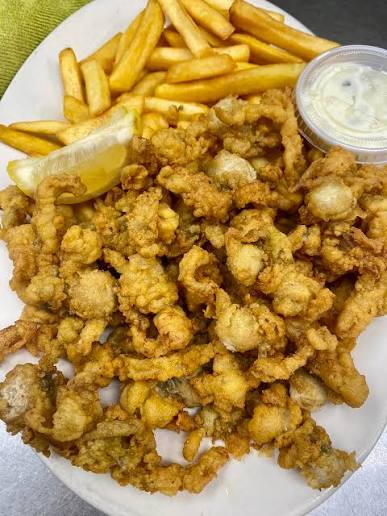
But try finding a proper plate of whole-belly fried clams—those glorious, golden, slightly obscene little nuggets of oceanic happiness—and suddenly everybody looks confused.
“Have you tried our calamari?”
Yes, Susan. I’ve tried the calamari.
For years, we’ve assumed that authentic New England soft-shell clams (Mya arenaria, for those who enjoy sounding insufferable, like me, at dinner parties) simply couldn’t survive the expensive, complicated journey across the continent.
Turns out, they’ve been here for more than 150 years.
And their arrival is a story of immigration, entrepreneurship, and what may be the most successful case of seafood smuggling in California history.
Give Me Your Tired, Your Poor, Your Huddled Mollusks
In the late 1860s and early 1870s, enterprising Californians started importing Atlantic oysters by rail to cultivate in San Francisco Bay.
Unfortunately, the oysters had neglected to declare all their traveling companions.
Hitchhiking among the shipments were tiny New England soft-shell clams. No tickets. No identification. Not even the courtesy of bringing a decent lobster roll.
By 1874, scientists had discovered these Atlantic interlopers happily living in San Francisco Bay.
The clams took one look at Northern California’s climate, realized the winters were easier than Massachusetts, and decided to stay.
They spread along the Pacific coast, turning up around Santa Cruz by the early 1880s.
Apparently, even 19th-century clams understood the appeal of coastal California real estate.
Unlike their human counterparts, however, they managed to establish themselves without paying property taxes, joining a homeowners association, or spending nineteen hundred months arguing with the Coastal Commission.
The Great Fried-Clam Injustice
So here’s the question that should have every East Coast transplant pounding the table:
If the clams are already here, why the hell can’t we get a basket of them with fries?
Well, as usual, the answer involves California regulations.
The historic commercial soft-shell clam fishery disappeared decades ago, and today’s commercial harvesting and sale of shellfish are tightly controlled by licensing, approved growing waters, and public-health requirements.
Add the occasional marine biotoxin warning, and suddenly opening a fried-clam shack becomes considerably more complicated than opening another boutique selling $180 linen shirts.
Recreational clamming is possible where permitted, subject to fishing regulations and current health advisories. But that’s rather different from running a restaurant supply chain.
So there they sit. Millions of New England expats, presumably beneath our coastal mud, living the California dream while their human counterparts wander around muttering about Marthas Vineyard.
Which raises another important question:
Could Monterey Bay become the fried-clam capital of the West Coast?
Probably not tomorrow. But a Knucklehead can dream.
The Fog & Fork Chowder Wars
Unable to secure our rightful inheritance of whole-belly fried clams, we turn to the next best thing.
Chowdah. (I spelled it correctly, damn you spell checker).
And Monterey Bay takes chowdah seriously. Almost alarmingly seriously.
New Englanders insist chowdah must be creamy. Manhattan loyalists insist tomatoes belong in the discussion. Californians put everything into a sourdough bread bowl because apparently we believe soup should arrive in edible luggage.
Meanwhile, certain waterfront establishments seem convinced that adding a view of the ocean justifies charging approximately the same amount as a modest used kayak.
So where should you go when you want a good bowl without financing a tourist attraction?
Here are three candidates for the Fog & Fork Chowder Hall of Fame.
Vivolo’s Chowder House — Pacific Grove
This place understands an essential truth: chowder is not supposed to be a delicate culinary experience.
It’s supposed to make you happy, slightly sleepy, and reconsider whatever you were planning to accomplish that afternoon.
Vivolo’s serves a classic New England-style chowder, including a sourdough bread bowl with a garlic-cheese lid.
Yes. A garlic-cheese lid.
Somewhere, a cardiologist just felt a disturbance in the Force.
Sea Harvest — Monterey & Carmel
Sea Harvest is for people who believe a seafood restaurant should spend more energy on the seafood than on explaining its architectural concept.
Part fish market, part restaurant, refreshingly short on theatrical nonsense.
Good chowder. Casual atmosphere. No need to pretend you understand the tasting notes of artisanal seawater.
And the reassuring knowledge that you’re in a place where fish is an actual product, not merely a decorative theme.
Phil’s Fish Market — Castroville
Phil’s is perhaps the only seafood institution in Monterey County that could move away from the ocean and somehow remain a coastal landmark.
Its relocation from Moss Landing to Castroville was a traumatic event for certain longtime customers. Some are still processing it.
But the chowder survives, along with the cioppino and enough seafood choices to keep an extended family arguing through lunch.
And there’s a certain charm to enjoying a bowl of clam chowder in the Artichoke Center of the World.
It’s California. We don’t ask too many questions.
Now, About Your Chowder Opinions…
We realize that publishing a list of three chowder destinations on Monterey Bay is roughly equivalent to declaring that only three guitarists deserve to be in the Rock & Roll Hall of Fame.
Someone is going to be offended.
Possibly everyone.
Excellent. We’d like to hear from you.
Who makes the best clam chowder in Monterey or Santa Cruz County? Not the place with the fanciest sign, the longest tourist line, or the bread bowl large enough to shelter a family of four.
The place that actually makes you happy.
And while we’re stirring the pot, we’re prepared to entertain the truly controversial: Is red chowder actually chowder? (The correct answer is “no.”) Does a bread bowl improve the soup, or merely provide an excuse to consume a loaf of sourdough at lunch? (Questionable at best). And how many potatoes can you add before the clams become unpaid extras?
Hit reply with your nomination and, more importantly, your completely unreasonable explanation of why everyone else is wrong.
We’ll publish the best arguments in an upcoming issue.
As for our missing fried clams, we’re not giving up.
After 150 years in California, surely these little New England immigrants deserve a chance to contribute to the local economy.
Preferably with tartar sauce.
— The Curious Knucklehead & Fog & Fork
KRML 94.7 FM — Monterey Bay. Human-curated music, community stories, and occasionally irresponsible enthusiasm for lunch.